
People's Daily, the mouthpiece of the ruling Communist Party of China, on Monday described Indo-US nuclear deal a "major blow" to non-proliferation, apparently reflecting the Chinese government's thinking on the issue.
China's foreign trade in 2004 is expected to reach an all-time record $1.1 trillion, up 30 per cent from the previous year, making the nation the third largest trade power in the world, minister of commerce Bo Xilai said.
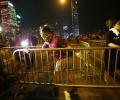
Amid raging pro-democracy protests in Hong Kong, China today threw its weight behind the region's Chief Executive CY Leung and warned demonstrators of "unimaginable" consequences if the standoff continues.
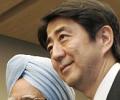
Piqued over Japan's warm ties with India, an influential Chinese daily on Tuesday said New Delhi's wisdom lies in dealing with its disputes with Beijing calmly undisturbed by "internal and international provocateurs".
Until now, the state-run Chinese media had only made factual reporting on the Indo-US nuclear deal. However, Beijing seems to have given the go-ahead to People's Daily to attack the deal.
The portal, under People's Daily, the mouthpiece of the ruling Communist Party of China currently offers its content in Chinese, Arabic, English, French, Japanese, Russian and Spanish, acting as a bridge between China and people from around the world. According to Brian Zhang, Editor of People's Daily Online, Indians were among the website's top 10 readers from around the world, which were topped by Chinese, Americans, French, British, Germans and Australians.
China appears to be making ground for claiming some 1,600 kms of Indian territory judging by reports in the state-owned media. Even as the two countries have been discussing the unresolved boundary issue for decades, the state-owned Xinhua and Global Times, an English language newspaper published by the People's Daily, the official mouthpiece of the ruling Chinese Communist Party, have described the Sino-Indian border as nearly 2,000 km long.

Crowds carrying lighted candles in memory of those killed in the fire at an apartment block reported under COVID-19 lockdown in Urumqi in Xinjiang shouted slogans against the arbitrary lockdowns by the government to curb the spread of the virus and in solidarity with the weekend protests in Shanghai.

Photos circulating in social media on Thursday showed two banners hung on an overpass of a major thoroughfare in the northwest of the Chinese capital, protesting against Xi's unpopular zero-COVID policy and authoritarian rule.

The official names of the 11 places were released on Sunday by the ministry, which also gave precise coordinates, including two land areas, two residential areas, five mountain peaks and two rivers and listed the category of places' names and their subordinate administrative districts, state-run Global Times reported on Monday.
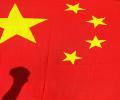
India will not join Japan's efforts to build a strategic counterweight against China along with the United States as it follows an independent foreign policy, the Chinese state media said on Tuesday, ahead of Prime Minister Narendra Modi's maiden visit to the US.
China's invitation to Hurriyat leader Mirwaiz Umar Farooq for a visit is 'unrelated' to India allowing the Dalai Lama to tour Arunachal Pradesh, Chinese scholars said on Monday, as they asserted that Beijing was 'not that petty-minded to take revenge'.Chinese experts, quoted by People's Daily, the mouthpiece of the ruling Communist Party, claimed that China is not interfering in the dispute over Kashmir between India and Pakistan despite Beijing's invitation to the Mirwaiz.

Criticising as 'nonsense', the Dalai Lama's reported statement that 'there exists fear in Tibet', the People's Daily -- the mouthpiece of the ruling Communist Party -- said it only showed that the Tibetan "spiritual" leader was pursuing a hidden agenda to split China.

India has emerged as a 'major power' by achieving outstanding results in economic development and social governance and its transformation as a stronger, assertive country has made it a 'new geopolitical factor', according to a commentary by a Chinese scholar in a state-run newspaper in Beijing.
The top weaponry is purchased through 'invisible military budget,' the Global Times, a sister publication of the ruling Communist Party of China's official mouthpiece, the People's Daily, said in a special report on the Indian armed forces.

China's national health commission said 39,452 new cases were reported on Monday, including 36,304 local asymptomatic cases, as authorities scrambled to contain the fresh surge in infections.

The chaos on its stock markets, a fierce battle between the old and new guard in the Communist Party and the restive border provinces of Tibet and Xinjiang forebode tough times ahead for China, says Claude Arpi.

Confronting a slowdown in growth, China says it will only increase its defence budget by 7.6% this year, against the anticipated rise of between 20% and 30%. 'It is difficult to explain the reduction in the Chinese defence budget,' says Claude Arpi. 'Is there a hidden budget? Possibly!'

The expulsion is likely to cloud India-China ties as Narendra Modi visits China for the G-20 Leaders Summit on September 4-5 and Xi Jinping is scheduled to be in Goa for the BRICS meeting on October 15-16.

Chinese President Xi Jinping has stressed the need for the recruitment of new talent to support the rapid modernisation of the armed forces and win future wars amid reports that the military has committed more resources to enrol 3 lakh personnel for frontline positions.

Will China's new military reforms endanger Xi Jinping's rule?
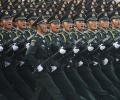
In a surprise development, a top Chinese military general has cast aspersions on the People's Liberation Army (PLA)'s much-publicised 'real combat-oriented exercises' as 'fake combat capabilities' at a time when Chinese President Xi Jinping has ordered it to prepare for 'maritime military struggles' to win wars.

The authorities have mounted massive containment measures including mass testing of about 90,000 people
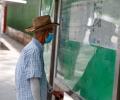
The Chinese capital reported 106 domestically transmitted COVID-19 cases since June 11 and a senior city official warned that the situation is "extremely severe" in Beijing where authorities have mounted massive containment measures including mass testing of about 90,000 people.
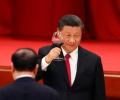
After the Ladakh fiasco where Xi Jinping did not expect the Indian Army to resist his land-grabbing tactics, he has to save face before his colleagues in the Communist party.' To bring the threat of a mega-dam to the northern Indian border is a clever move, observes Claude Arpi.

'The "Hollandisation" of British policy may not bring the expected gains as the future may show,' says Claude Arpi.

One thing Beijing must understand is that India is not obsessed with being a threat to China but only wants a rightful place for itself in the world, says Sanjeev Nayyar.
